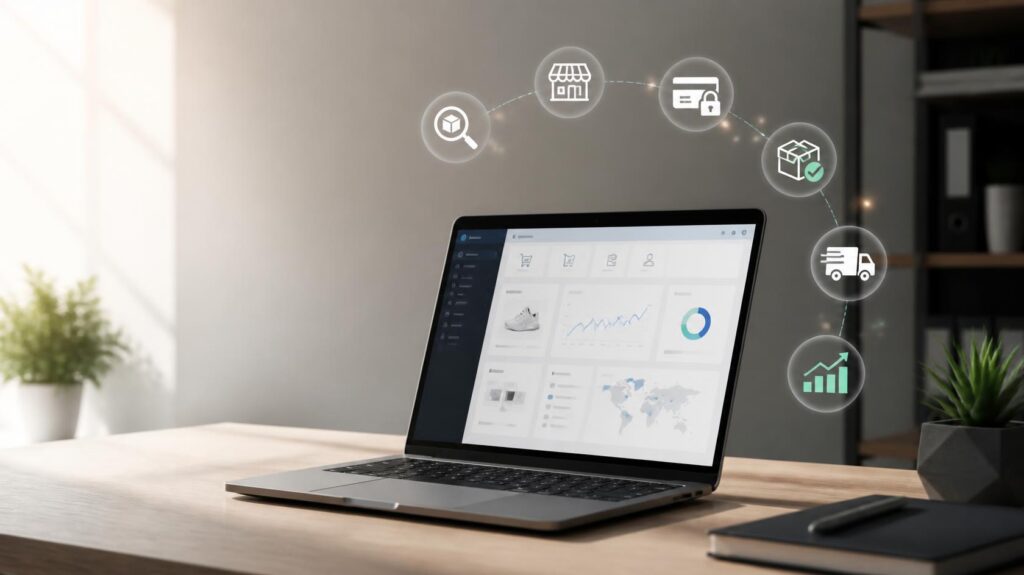
Starting an online business means creating a real business that can attract customers, accept orders or bookings, receive payments, and deliver what customers have purchased.
You do not need to build everything at once. The practical approach is to work through the business in the same order a customer experiences it:
What are you selling? → Who is it for? → Where will people buy it? → How will they pay? → How will you deliver it? → How will you bring in more customers?
This guide takes you through each stage.
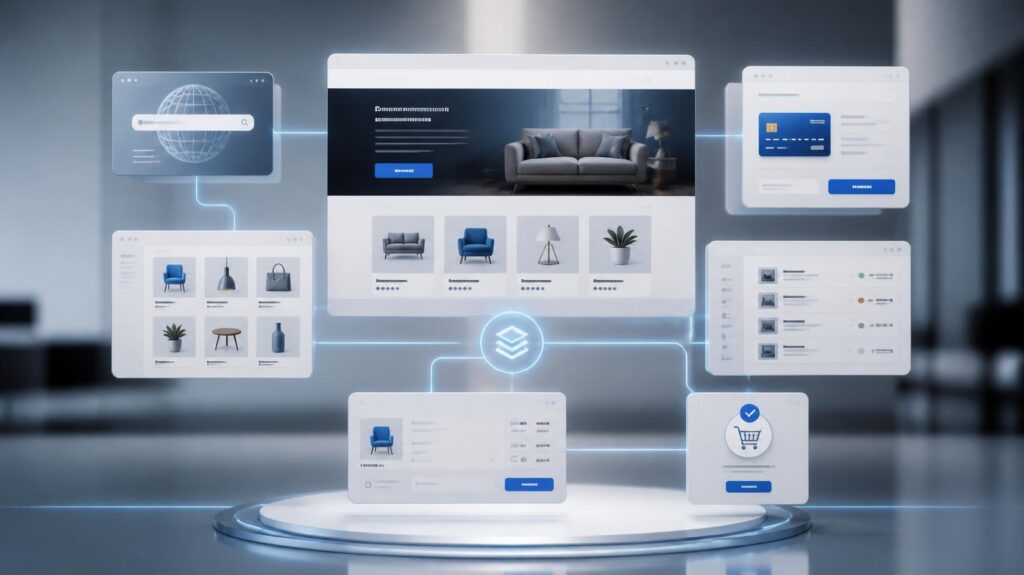
1. Decide what you are going to sell.
Start with the offer, not the website.
Most online businesses fall into one of three main categories:
- Physical products: Products that are stored, shipped, or physically delivered to customers.
- Services: work expertise or a specific result provided to a customer.
- Digital products: products delivered electronically, such as courses, templates, software, guides, or downloadable files.
You can also combine these models. For example, a business might sell physical products and offer consulting or sell a service together with a digital product.
Before spending money on a website, advertising, or inventory, define exactly what the customer will pay you for.
Then determine:
- Who is most likely to buy it
- What problem or need does the offer address
- What makes your offer useful or different
- What customers currently pay for similar solutions
- What it will cost you to provide the product or service
- Whether there is enough potential demand to make the business worthwhile
You do not need to know everything before starting, but you should have enough information to make a sensible decision about the offer.
Next: How to Find a Profitable Online Business Idea
2. Check whether the business can make money | Check the basic economics
An online business can generate sales and still lose money.
Before launching, calculate the basic economics of your offer.
For a physical product, consider the cost of the product, packaging, shipping, platform fees, payment fees, returns, and marketing.
For a service, consider the time required to deliver the work, software or operating costs, payment fees, marketing expenses, and any other costs involved in serving the customer.
For a digital product, consider the cost of creating the product, the platform, payment processing, customer support, and marketing.
Your basic calculation is
Selling price − total cost of providing and selling the offer = money remaining before other business expenses and taxes
You do not need a complicated financial model to begin. You do need to know whether the price you plan to charge leaves enough room for the business to operate and grow.
If the numbers do not work on paper, changing the website will not fix the business.
3. Choose where customers will buy from you.
Once you know what you are selling and the basic economics work, choose the selling channel.
There are two broad routes.
Build your own online store or website.
This gives you your own online business presence where customers can discover your products or services, place orders or bookings, and interact with your business.
For an e-commerce store, platforms such as Shopify and WooCommerce provide tools for creating and managing an online store.
Shopify’s official online-store guide explains the setup process, including choosing a platform, building the store, setting up checkout and shipping, testing, and launching.
WooCommerce’s official getting-started documentation provides guidance on setting up a store and managing products, shipping, taxes, payments, and orders.
See also: How to Start a Shopify Store
See also: How to Start a WooCommerce Store
Sell through an established marketplace.
A marketplace gives you access to an existing sales environment rather than requiring you to build the entire sales system yourself.
Amazon is one example of physical products. Its official seller process covers registration, business and seller information, billing information, store and product information, identity verification, and then account configuration through Seller Central.
See also: How to Start Selling on Amazon
The right choice depends on the business. You can also use more than one channel as the business grows.
4. Take care of the business requirements.
Before you begin accepting customers, find out what legal, tax, registration, licensing, and consumer requirements apply to the business.
The requirements depend on where the business operates, what it sells, and how it is structured. Do not assume that every online business has the same requirements.
Start with the official government or regulatory information for the place where your business operates and check requirements relating to:
- Business registration
- Taxes and recordkeeping
- Licenses or permits
- Consumer protection
- Refund and cancellation rules
- Privacy and customer information
- Product-specific regulations
- Selling to customers in other locations
If the requirements are unclear, get advice from an appropriately qualified professional rather than guessing.
The purpose of this step is straightforward: make sure you understand the requirements that apply to your business before you start operating at scale.
5. Set up the online business
Now create the system customers will use to buy from you.
The setup depends on what you are selling.
If you sell physical products
Create a store where customers can view products, understand the price and delivery terms, place an order, pay, and receive information about fulfillment.
The basic process is
Choose the platform → create the store → add products → connect your domain → configure payments → configure delivery → test an order → launch
Shopify’s official guide follows a similar progression, including products, store setup, checkout, shipping, testing, launch, and ongoing optimization.
If you sell a service
Create an online presence where customers can understand the service and take the appropriate next step.
You can build the website yourself using a suitable platform or hire a professional web designer, developer, freelancer, or agency.
Choose the setup according to the way customers will buy:
- Request a quote: Use this when the price depends on the customer’s requirements.
- Online booking: Use this when customers can select an appointment or consultation.
- Direct purchase: Use this when the service has a fixed price and can be purchased immediately.
- Contact or inquiry: Use this when you need to discuss the customer’s requirements first.
The website does not need to be complicated. It needs to make the service understandable and give the customer a clear path to hiring you.
If you sell digital products
Set up a system that allows customers to understand the product, pay for it, and receive access or a download electronically.
The basic process is
Create the product and publish the offer. → connect payment → configure delivery → test the purchase → confirm the customer receives the product
The customer should be able to complete the purchase without you manually handling every order unless that is intentionally part of your business model.
6. Add your products or services.
Now put the actual offer into your selling system.
Do not make customers guess what they are buying.
For a physical product, provide accurate information about the product, important features, variations, price, availability, and delivery.
For a service, explain what the customer is hiring you to do, what is included, what they receive, how the process works, and how they can get started.
For a digital product, explain exactly what the customer receives, the format, what is included, and how they will access it.
Before purchasing, a customer should be able to answer four questions:
What am I buying?
What will I receive?
How much will it cost?
What happens after I pay?
If those answers are unclear, improve the offer before spending money to send more people to it.
7. Set up payments
You now need a reliable way for customers to pay.
The payment setup depends on your business model, selling platform, location, currency, and the payment providers available to you.
A typical setup might look like this:
- Physical product: Payment is completed through the store checkout.
- Fixed-price service: Payment can be collected when the service is purchased or booked.
- Custom service: The customer requests a quote, approves the price, and then makes the required payment.
- Digital product: Payment connects directly with digital delivery.
Choose a payment provider supported by your selling platform and available for your business.
During setup, the provider may require business, identity, banking, or other verification information.
Before accepting real orders, test the entire payment process. Make sure the payment is recorded correctly, the customer receives confirmation, and the business receives the information needed to fulfill the order.
8. Prepare delivery and fulfillment
A sale is not complete until the customer receives what they purchased.
Physical products
Decide how products will be stored, packed, shipped, tracked, and returned.
You can handle fulfillment yourself or use a third-party fulfillment service. Amazon sellers can also consider Amazon’s fulfillment options when deciding how orders will be handled.
Your process should answer the following:
Where is the product stored? → Who prepares the order? → How is it shipped? → How does the customer receive it? → What happens if it is returned?
Services
Define what happens from the moment a customer hires you until the work is completed.
For example:
The customer books or approves the service, you receive the required information, work begins, you communicate as necessary → the completed service is delivered.
Make sure you know what information you need from the customer and how long the work normally takes.
Digital products
Make sure the system delivers the correct product or access after payment.
Test the process yourself before launch, so you know the customer receives exactly what they purchased.
9. Test everything before launching.
Before announcing your business, complete the entire customer journey yourself.
Start as though you are a new customer:
Find the business → view the offer → place an order or booking → make a payment → receive confirmation → receive the product or service.
Check the important parts:
- Website or store
- Product or service information
- Checkout
- Payment
- Contact forms
- Booking system
- Order confirmation
- Digital delivery
- Shipping information
- Customer instructions
Test the business on the devices your customers are likely to use.
A test order or booking can reveal problems that are easy to miss when you are looking at the business as its owner.
Fix those problems before spending money on advertising or sending a large number of customers to the business.
10. Launch and get your first customers.
Once the business can successfully take and fulfill an order, booking, or service request, you are ready to start attracting customers.
Choose the channels that your target customers actually use.
Depending on the business, these might include:
- Search engines
- Social media
- Content marketing
- Referrals
- Partnerships
- Relevant online communities
- Paid advertising
You do not need to use every channel at the same time.
Start with one or two channels that make sense for your audience, learn what works, and expand from there.
Your first objective is not to reach everyone. It is to get your offer in front of the right people and learn what makes them take action.
11. Measure the results and improve the business.
Launching is the beginning of the learning process, not the end.
Pay attention to what happens after people discover your business.
- Are they visiting your website or marketplace listing?
- Are they viewing the offer?
- Are they contacting you?
- Are they starting checkout?
- Are they completing purchases?
- Are they returning?
The answers can show you where the business needs improvement.
For example, if people visit but do not purchase, examine the offer, pricing, product information, trust, and checkout process.
If people purchase but do not return, examine the product quality, service experience, delivery, customer support, and follow-up.
Use real customer questions, feedback, sales data, and business results to decide what to improve next.
The complete roadmap
Starting an online business can be reduced to one practical sequence:
Choose the offer → validate the opportunity → understand the economics → choose where customers will buy → handle the applicable business requirements → build the selling system → add the offer → set up payments → prepare fulfillment → test everything → launch → attract customers → measure and improve.
You do not need a huge operation on the first day.
You need a working business system that can take a real customer from discovering your offer to successfully receiving what they paid for.
Then you improve that system as you learn what customers actually want.
Choose your next step.
The general process is now clear, but the exact setup depends on the type of online business you want to build.
If you are creating your own e-commerce store:
Explore: How to Start a Shopify Store
Explore: How to Start a WooCommerce Store
If you want to sell physical products through a marketplace:
Explore: How to Start Selling on Amazon