Table of Contents
Vanguard’s two largest U.S. stock ETFs, VOO and VTI, tend to be the first names that come up when a simple, low-cost stock market portfolio is being built. Both cost 0.03% a year, which is $3 on every $10,000 invested. Both are passive, liquid, and tied to the U.S. economy.
With so many similarities, a natural question follows:
Would holding both double the diversification?
It would not, and the reason sits in how these funds are built.
Is Owning Both VOO and VTI Worth It?
Mostly no. Both funds weight companies by market capitalization, so the largest companies drive the result in each one. Because VTI holds the same giant companies as VOO plus a long tail of smaller ones, a portfolio that holds both is VOO with a slightly heavier tilt toward mid- and small-cap stocks. That tilt is real but modest, and a single fund can deliver it more simply.
What Is an ETF, and What Do VOO and VTI Mean?
What an ETF Is
An ETF, short for exchange-traded fund, is a single investment that holds a large basket of stocks (or other assets) inside it. Buying one share of an ETF gives an investor a small slice of every company in the basket, rather than a stake in just one business. ETFs trade on the stock market the same way individual stocks do, so they can be bought and sold through any brokerage account during market hours at a price that updates throughout the day.
Many ETFs are index funds, meaning they do not try to beat the market. They copy a published list of companies, called an index, and hold the same stocks in the same proportions. Because no team is picking stocks, the running cost is very low. That cost is shown as the expense ratio, the yearly fee taken from the fund. An expense ratio of 0.03% means $3 per year for every $10,000 invested.
What VOO and VTI Are
VOO and VTI are ticker symbols, the short codes used to find an investment on a brokerage platform, much like AAPL for Apple. Both are index ETFs run by Vanguard, one of the largest investment companies in the world.
- VOO is the Vanguard S&P 500 ETF. It holds roughly 500 largest U.S. companies, following the S&P 500 index.
- VTI is the Vanguard Total Stock Market ETF. It holds nearly every publicly traded U.S. company, from the largest corporations down to small ones, following the CRSP U.S. Total Market Index.
Put simply, VOO is a fund of the biggest U.S. companies, while VTI is a fund of the biggest U.S. companies plus thousands of smaller ones. That difference is the whole reason for the overlap discussed below.
Why Beginners Often Start With Funds Like These
A single share of either fund spreads money across hundreds or thousands of companies at once, so one company’s bad quarter has little effect on the total. For many first-time stock market investors, that built-in diversification and the very low fee are the main attractions compared with picking individual stocks. Both funds also pay dividends, usually a modest yield that changes over time, and how dividends affect a share price is useful to understand before buying. Placing the purchase itself involves a choice between a market order and a limit order, which is explained in Market Order vs. Limit Order: Which Should You Use as a Beginner?
What Each Fund Actually Holds
VOO tracks the S&P 500 Index, roughly 500 of the largest publicly traded U.S. companies. VTI tracks the CRSP U.S. Total Market Index, which covers roughly 3,500 or more companies across large-, mid-, and small-cap segments, according to ETF.com’s comparison. The exact count shifts over time as the index is rebalanced, so Vanguard’s own fund pages for VOO and VTI are the best place to confirm current figures.
Their largest positions are nearly identical: Apple, Microsoft, Nvidia, Amazon, Alphabet, Meta, and Broadcom sit near the top of both.
How Much Do VOO and VTI Overlap?
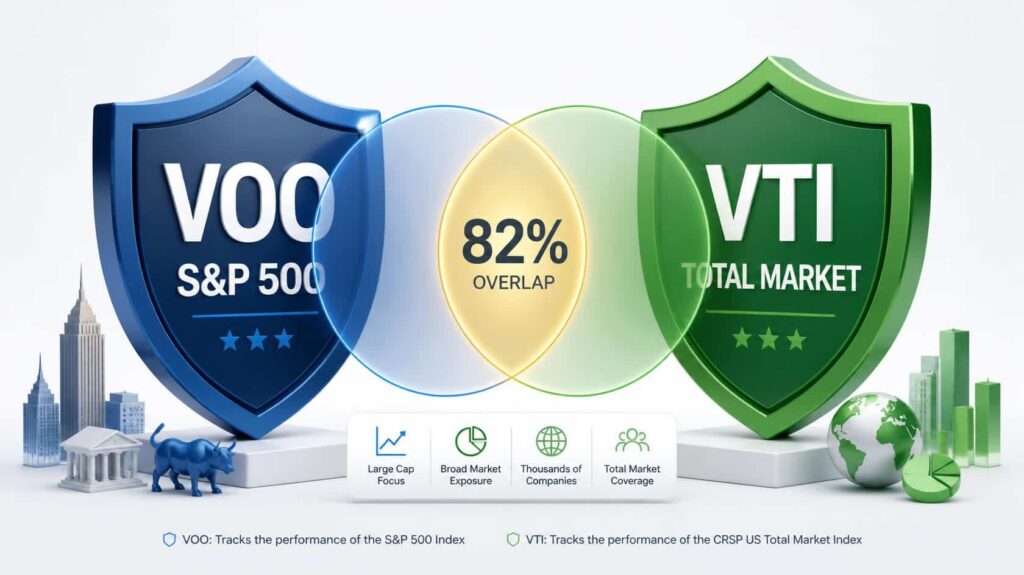
Estimates of the overlap vary by source and by date, so any single figure should be read with care. One comparison tool puts the overlap at about 89% by weight. Another source places 82% to 86% of VTI in stocks that VOO also owns. The size split inside VTI is reported differently as well: ETF.com cites roughly 72% large-cap, 17% mid-cap, and 11% small-cap, while other providers show closer to 82%, 12%, and 6%. Differences in how “large-cap” is defined and when the data was pulled explain most of the gap.
Every version points the same way: the smaller companies that separate VTI from VOO make up a minority of the fund, so the two behave very similarly.
VOO vs. VTI by the Numbers
| Feature | VOO | VTI |
|---|---|---|
| Tracked index | S&P 500 | CRSP U.S. Total Market |
| Approximate holdings | ~500 | ~3,500+ |
| Expense ratio | 0.03% | 0.03% |
| Market-cap coverage | Large-cap | Large, mid, and small-cap |
| Large-cap share of fund | ~100% | ~72% to 82% (varies by source) |
| Top holdings | Nearly identical | Nearly identical |
Which Fund Has Performed Better?
Over long stretches, the gap between the two has tended to be small. ETF.com has noted that the difference in 10-year annualized returns has rarely exceeded 0.5% in either direction and often sits closer to 0.1% to 0.2%. Which fund comes out slightly ahead depends on which part of the market led during the period measured.
When large U.S. companies lead, VOO tends to edge ahead, since it holds only large-cap stocks. When smaller companies lead, VTI tends to benefit from its mid- and small-cap holdings. Because the leader changes from one period to the next, any specific return figure goes out of date quickly. Current performance for each fund is listed on Vanguard’s VOO and VTI pages, and past returns say little about which fund will come out ahead over the next ten years.
When Holding Both Stock Market Funds Does Make Sense
Holding both is rarely a deliberate strategy. It usually happens because of how accounts are structured.
Limited fund menus. Many employer 401(k) plans offer an S&P 500 index fund but no total-market option. An investor in that position might hold the S&P 500 fund at work and place VTI, or a mid- and small-cap “completion” fund such as VXF, in an IRA or taxable account. That arrangement can approximate total-market exposure across the whole portfolio, even though each account looks different on its own.
Existing holdings in a taxable account. An investor who already owns both and faces a large capital gain on one of them may reasonably leave both in place and direct all new contributions into a single fund rather than trigger a tax bill to tidy up.
Tax-Loss Harvesting: Using VOO and VTI as a Pair
In a taxable account, selling a fund at a loss can offset gains elsewhere, but the IRS wash sale rule disallows the loss if a “substantially identical” security is bought within 30 days before or after the sale. The rule is found in Section 1091 of the tax code and explained in IRS Publication 550.
The IRS has never published a precise definition of “substantially identical” for funds. In practice, many tax professionals treat funds that track different indexes as generally not substantially identical, which is why selling VOO and buying VTI (or the reverse) is a commonly discussed harvesting swap. Funds tracking the same index, such as VOO and another provider’s S&P 500 ETF, are more often treated as a risk.
Two cautions apply. First, this is a gray area rather than a guarantee, since VOO and VTI hold overlapping stocks. Second, dividend reinvestment counts as a new purchase and can trigger a wash sale if it falls inside the window. The rule also reaches across accounts, including IRAs and a spouse’s accounts. A tax professional should be consulted before relying on this strategy.
Considerations for Investors Outside the U.S.
Non-U.S. residents who buy U.S.-domiciled ETFs like VOO and VTI are generally subject to a 30% U.S. withholding tax on dividends by default. Many countries have tax treaties with the United States that reduce that rate, often to 15%, so the actual figure depends on the investor’s country of residence. IRS Publication 515 covers withholding for nonresident aliens. U.S. estate tax can also apply to nonresidents holding U.S. assets above a much lower threshold than citizens enjoy.
Because of these issues, some international investors use Ireland-domiciled UCITS funds that track similar indexes. These funds are structured differently for tax purposes, and local rules vary, so the details should be confirmed with a local tax adviser.
Which Stock Market ETF Fits Which Situation
The choice usually comes down to what the portfolio is trying to do:
- If the goal is low-cost exposure to the largest U.S. companies and simplicity, VOO fits. It tends to do slightly better in periods when large companies lead the market.
- If the goal is owning the whole U.S. market, including smaller companies that may become tomorrow’s large caps, VTI fits. Amazon, Google, and Netflix were all mid- or small-cap stocks before joining the S&P 500.
- If a portfolio already holds one of the two, adding the other is unlikely to change much. A better use of new money is often a different asset class, such as international stocks or bonds, which is a different kind of diversification.
For readers newer to the stock market, the beginner’s guide to investing covers account types and first steps, and Index Funds vs. Individual Stocks explains why broad index funds are the usual starting point.
Want to see if your favorite stock is currently trading at a discount or premium? Try our free Stock Intrinsic Value Calculator powered by Benjamin Graham’s valuation formula.
FAQs
Is it worth owning both VOO and VTI?
Usually not. The two funds share most of their weight in the same large companies, so holding both adds little diversification. Owning both is not harmful, but it is mostly redundant.
Which is better, VOO or VTI?
Neither is better in every period. The lead changes with the market: VOO tends to edge ahead when large-cap stocks lead, while VTI offers broader coverage that could help if smaller companies lead in the future. The fees are identical.
Is VTI less risky than VOO in a stock market downturn?
Not meaningfully. Because both funds are weighted by market capitalization, large companies drive most of the movement in each, and the two have fallen and recovered in very similar patterns. VTI’s small-cap holdings can make it slightly more volatile.
Can selling VOO and buying VTI trigger the wash sale rule?
The funds track different indexes, so many tax professionals consider the swap generally acceptable, but the IRS has not defined “substantially identical” for funds. It is a gray area, and a tax professional should confirm.
What should an investor do if both funds are already owned?
In a taxable account, selling one can create a capital gains bill. Many investors leave existing holdings alone and send future contributions to a single fund.