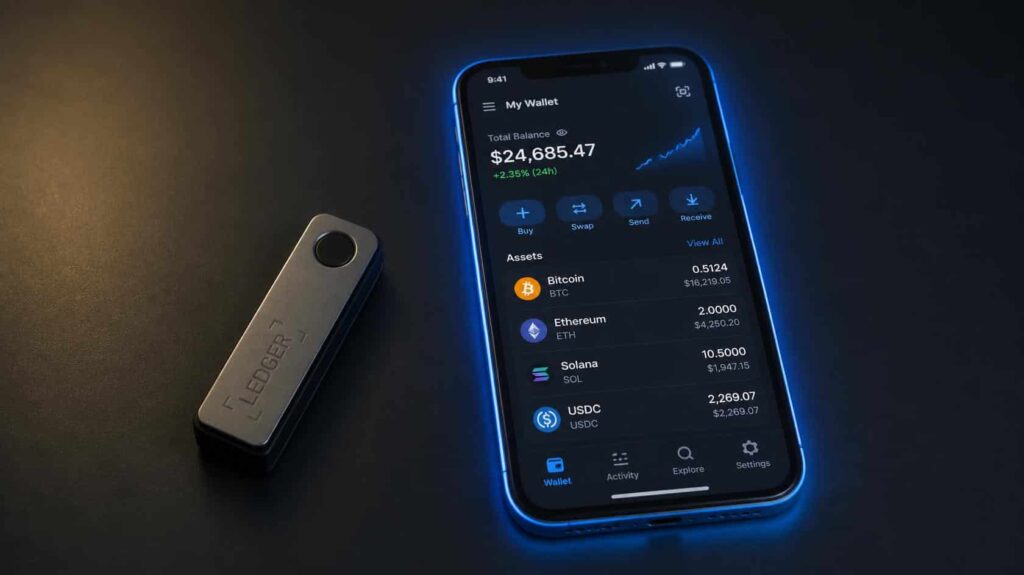
Anyone new to crypto runs into the hot wallet vs. cold wallet question almost immediately; it’s the first real security decision you have to make.
“Bitcoin is not money for the internet. It is the internet of money,” Bitcoin educator Andreas Antonopoulos once put it. That line explains more about wallets than most tutorials do.
Your crypto never actually goes anywhere; it stays on the blockchain the whole time. What a wallet really holds is your private key: the secret code that proves those coins are yours and lets you move them.
So the entire hot-versus-cold debate really comes down to one question:
Where does that key live?
Crypto theft isn’t a rare, fringe concern either. Blockchain analytics firm TRM Labs recorded more than 200 separate hacking incidents against crypto holders and companies in just the first half of 2026 alone, the most ever tracked in a single six-month period, totaling nearly $1 billion in losses. Understanding where your key actually lives and what can go wrong with each option isn’t optional homework. It’s the whole ballgame.
How Do Private Keys Actually Work in Crypto?
Before comparing the two wallet types, it helps to understand what a wallet is actually doing behind the scenes.
Every crypto wallet is built around a pair of keys: a public key and a private key. The public key works like your account number; you can hand it out freely so people know where to send you funds. The private key works like the password that actually controls that account; whoever holds it can move the funds, no questions asked.
A wallet, hot or cold, is really just a tool for storing and using that private key. It doesn’t hold your coins the way a physical wallet holds cash. Your coins always live on the blockchain itself; the wallet just holds the key that proves they’re yours. That distinction matters, because it means losing a wallet device doesn’t necessarily mean losing your crypto. As long as you still have your seed phrase, you can recover access on a new device. Losing both the device and the seed phrase, though, generally means the funds are gone for good.
What Is a Crypto Hot Wallet?
A hot wallet keeps your private key on something connected to the internet: an app on your phone, a browser extension like MetaMask, or your account on an exchange like Coinbase. It’s fast. You can buy, sell, or send crypto in seconds, right from your pocket.
That speed has a price, though. Since a hot wallet is always online, it’s also always within reach of anyone trying to get in, hackers, malware, or the occasional phishing email that looks a little too convincing. A good way to think about it: a hot wallet is like the cash you actually carry around. Fine for what you’re spending soon. Not where you’d stash your savings.
Common hot wallets include MetaMask and Trust Wallet, which you install yourself and control directly, and exchange-hosted wallets like Coinbase or Binance, where the platform technically holds the keys on your behalf. That last distinction matters more than most beginners realize; it’s often summed up as “not your keys, not your coins,” meaning if an exchange gets hacked or freezes withdrawals, you don’t have the same direct control you would with a wallet where you hold the private key yourself.
What Is a Crypto Cold Wallet?
A cold wallet keeps your private key completely offline. Most people picture a small hardware device that looks a bit like a USB drive, though some go lower-tech with a piece of paper or even a metal plate with the key stamped into it. A hardware device is just the most common way people do cold storage, not the only way. And because none of it ever touches the internet, a hacker sitting somewhere else in the world simply has nothing they can reach.
That security isn’t free, either. Using a cold wallet means physically plugging in or scanning a device every single time you want to move funds, a deliberate bit of friction that trades speed for safety. If you’re brand new to this, expect a slightly steeper learning curve than just opening an app and tapping “buy.”
The two most recognized hardware wallet brands are Ledger and Trezor, both of which store the private key on a dedicated chip that never exposes it to an internet-connected computer, even while you’re using the device to approve a transaction.
What Is a Crypto Warm Wallet?
You’ll probably run into a third term at some point: the warm wallet. It sits somewhere in between. Some warm wallet setups keep the private key split up or encrypted in a way that adds security beyond a normal hot wallet while still staying faster to access than something fully offline. It’s not something most beginners need to worry about; it shows up more with advanced holders or institutions juggling speed and safety at scale, but it’s worth knowing the term if you come across it.
Crypto Hot Wallet vs. Cold Wallet at a Glance
| Hot Wallet | Cold Wallet | |
|---|---|---|
| Connection | Always online | Always offline |
| Speed | Instant | Requires physical device |
| Best for | Small amounts, frequent use | Long-term holdings |
| Biggest risk | Remote hacking, phishing | Physical loss, firmware flaws |
| Common examples | MetaMask, Trust Wallet, Coinbase | Ledger, Trezor, paper wallets |
Are Crypto Cold Wallets Still as Safe as People Assume?
Worth addressing head-on, because this isn’t some hypothetical scare story; it actually happened.
In August 2026, a firmware flaw in Coldcard, a hardware wallet that had long been treated as one of the gold standards of cold storage, let attackers reconstruct victims’ private keys without ever physically touching their devices. Over $100 million in Bitcoin got drained from thousands of wallets before anyone caught what was happening.
One story from that hack says more than any warning label ever could. A man named Jonathan Goodman had done everything right, by the book: multiple hardware wallets, backups kept in separate physical locations, his seed phrase stamped into metal so fire couldn’t destroy it. He lost everything anyway. All three of his devices shared the same underlying flaw in how they generated private keys, so stacking up “layers” of protection didn’t actually help; the flaw was sitting underneath every single one of them at once.
None of this means cold wallets are unsafe. They’re still far safer than leaving a large amount sitting on an exchange. What it really means is that “offline” only protects you from one category of risk: remote hackers reaching in over the internet. It doesn’t protect you from everything. A cold wallet is still hardware running software, and hardware can have its own flaws baked in.
How Do You Keep a Crypto Wallet Secure?
Whichever type you end up using, a handful of habits matter more than which wallet brand you pick:
- Turn on two-factor authentication on any hot wallet or exchange account; it stops a huge share of account takeovers even when a password leaks.
- Never type your seed phrase into a website or app, no matter how official it looks. Legitimate wallets only ask for it once, during setup or recovery, never to “verify” or “unlock” your account.
- Keep your seed phrase written down offline, not in a phone note, email draft, or cloud document. Any of those turn a cold wallet’s offline protection into a hot-wallet-level risk the moment the phrase itself is stored online.
- Double-check firmware update sources directly from the manufacturer’s official site, since fake “urgent update” links are a common phishing tactic following news of any wallet hack.
How Do Long-Term Bitcoin Holders Actually Store Their Crypto?
Some of the earliest, biggest Bitcoin holders treat cold storage almost like a physical security problem, not a digital one. The Winklevoss twins, among the first Bitcoin billionaires, have talked about printing out their private keys and physically splitting them across separate safety deposit boxes in different locations, so no single box, device, or place ever holds the whole key.
Most people don’t need to go that far. But the instinct behind it is the part worth borrowing: don’t put all your protection in one place, one device, or one company’s firmware. That’s the actual lesson, not the specific method.
Crypto Hot Wallet or Cold Wallet: Which Should You Use?
Honestly, it depends on how much you’re holding and what you’re actually doing with it; there’s no single right answer for everyone.
A hot wallet tends to make more sense for smaller amounts you’re actively using for trading, spending, or moving funds between platforms. When the amount at stake is limited, the convenience is worth the trade-off.
A cold wallet tends to make more sense for larger amounts you plan to hold for a while. A lot of experienced holders end up using both a hot wallet for whatever they need day-to-day and a cold wallet for the bulk sitting untouched. That split also happens to limit how much a hot-wallet hack could ever cost you in the first place.
FAQs About Hot and Cold Wallets
Is Coinbase a Hot or Cold Crypto Wallet?
A standard Coinbase account is a hot wallet; your funds sit online, held by the exchange. Coinbase also offers separate cold storage options if you want offline protection for larger amounts.
Can You Give an Example of a Crypto Hot Wallet?
MetaMask, Trust Wallet, and exchange accounts like Coinbase or Binance are all hot wallets- basically anything you reach through an app, browser, or website while connected to the internet.
What’s a Crypto Seed Phrase, and Why Does It Matter?
It’s a string of 12 or 24 words that can restore access to your wallet if the device gets lost or damaged. Think of it as a backup to your private key itself, which is exactly why losing it or exposing it is just as serious as losing the wallet.
Should I move all my crypto to a cold wallet?
Not necessarily. Cold storage is generally the safer home for larger, long-term holdings, but moving every last coin there can get impractical if you’re actively trading or spending. Most holders split things between both, based on how soon they expect to use it.
Source: The Coldcard hack, explained — TechCrunch