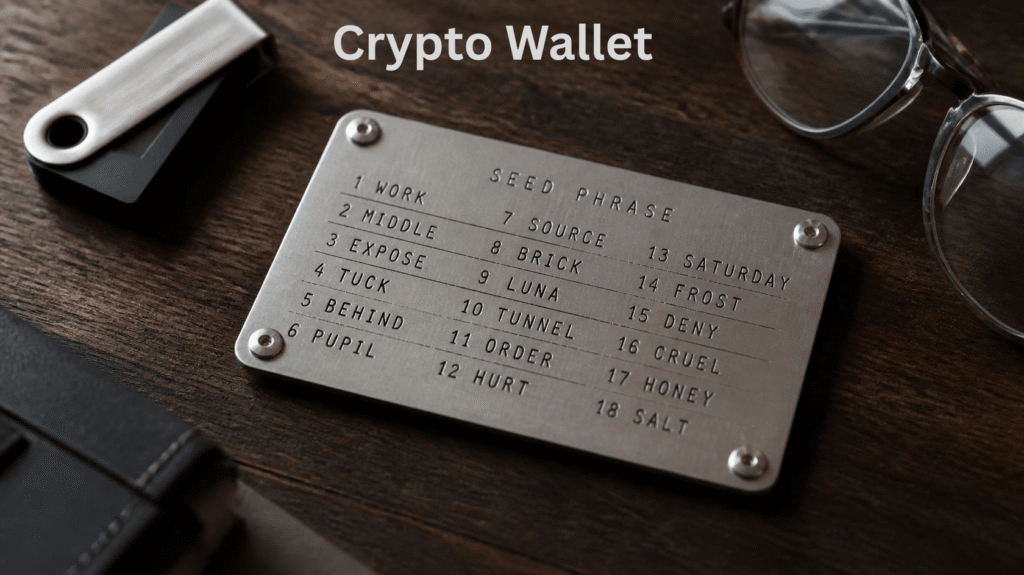
If you’ve ever set up a crypto wallet, you’ve seen it: a screen showing 12 or 24 random words, with a warning to write them down and never lose them. That’s your seed phrase, and it’s the single most important piece of information tied to your crypto.
Most people click past it fast, eager to start buying Bitcoin or trading. That’s a mistake. Understanding what a seed phrase actually does and what can go wrong when it’s mishandled, even by major platforms, is the difference between owning crypto safely and losing it permanently.
What Is a Crypto Seed Phrase?
A seed phrase is a list of 12 or 24 simple, unrelated words that your crypto wallet generates the first time you set it up. Together, those words work as a master key: they can recreate your entire wallet and every private key inside it, on almost any compatible wallet app, on any device.
The words aren’t random in the casual sense; they’re pulled from a fixed list of 2,048 words defined by a technical standard called BIP39 (Bitcoin Improvement Proposal 39). That standard is what lets a seed phrase generated in one wallet get typed into a completely different wallet app and still restore the exact same funds. It’s also why seed phrases look like plain English rather than a string of letters and numbers: words are far easier to write down accurately and recover later than 64 random characters would be.
You’ll sometimes see a seed phrase called a “recovery phrase” or “mnemonic phrase.” All three terms mean the same thing.
Here’s roughly what one looks like (this example is illustrative only, not a real wallet): timber salmon coral neighbor jungle velvet orbit cactus lantern squad hollow mango
You never type this phrase in during normal buying, selling, or sending. It only comes into play when you’re setting up a wallet for the first time or recovering one you’ve lost access to.
How a Bitcoin Seed Phrase Actually Works
Behind the scenes, your seed phrase isn’t just a label; it’s mathematically converted into a long cryptographic “seed” number. That number is then used to generate every private key your wallet will ever need, following the same BIP39 process every time. This is why losing your phone doesn’t mean losing your Bitcoin: reinstall a compatible wallet, enter the same 12 or 24 words, and the software rebuilds the exact same keys and rediscovers your funds on the blockchain.
The wallet handles all of this automatically. You’ll rarely see the private keys themselves; you’ll only ever handle the seed phrase during setup or recovery.
That convenience is also the risk. Because a single phrase can rebuild your entire wallet, anyone who gets hold of it controls everything in that wallet, no password or two-factor code required. Unlike a bank account, there’s no customer service line that can reverse a transaction or reset your access. If it’s gone, it’s usually gone for good.
Seed Phrase vs. Private Key: What’s the Difference
These two terms get used interchangeably a lot, but they’re not quite the same thing, and knowing the difference matters for how you protect each one.
Seed phrase: The backup for your entire wallet. One phrase can regenerate every private key and every address tied to that wallet. Human-readable, meant to be written down and stored offline.
Private key: A long string of letters and numbers that controls one specific address within your wallet, not the whole wallet. Your wallet uses it automatically to sign each transaction. Some wallets generate a fresh address (and technically a new key derived from the same seed) for every transaction to improve privacy.
Think of the seed phrase as the master key to the whole building, and private keys as the individual keys to each room, all cut from that same master. Lose the master key, and every room is compromised at once.
When Even a Major Crypto Exchange Gets It Wrong
The golden rule of seed phrase security is simple: never type it into a website, not even an official one. In March 2026, that rule got tested in a very public way.
As Coinbase wound down its Commerce product and merged it into Coinbase Business ahead of a March 31 deadline, the company built a webpage that asked merchants to manually paste their 12-word seed phrase into a plain-text form to recover funds. Blockchain security researchers, including on-chain investigator ZachXBT and SlowMist’s founder, flagged the page almost immediately, warning that it directly contradicted the industry’s most basic security principle and effectively handed scammers a ready-made phishing template. The page’s help documentation even walked users through copying their phrase out of Google Drive to paste it in.
Coinbase left the page live through the criticism, pointing users instead toward a separate, safer withdrawal tool that didn’t require entering a phrase directly. The episode came just two months after a separate Coinbase impersonation scam had already cost users roughly $2 million, a scheme that relied on people trusting anything that looked official.
The lesson isn’t that Coinbase is uniquely careless. It’s that the rule “never enter your seed phrase online” has to apply even when the site asking looks completely legitimate, because sometimes it is legitimate, and the request is still dangerous.
How to Store Your Bitcoin Seed Phrase Safely
Write it down offline, on something durable. Paper works, but it burns, floods, and fades. Many long-term holders use engraved or stamped metal backup plates specifically because they survive fire and water damage that would destroy a paper copy.
Never store it digitally. That means no notes apps, no emails, no cloud drives, and no screenshots. A screenshot in particular can silently back itself up to the cloud without you realizing it, turning an offline safeguard into an online liability.
Keep it somewhere physically secure. A home safe, a lockbox, or a bank safety deposit box all work. Some people split their phrase across two locations to reduce the risk of any single point of failure, though that adds its own risk of losing one piece.
Treat every request for it as a red flag. No legitimate wallet provider, exchange, or support agent will ever ask for your seed phrase, over the phone, by email, or through a web form, as the Coinbase Commerce episode should make clear even when the source seems official.
What to Do If Your Seed Phrase Is Exposed
If you believe someone else has seen or accessed your seed phrase, treat it as compromised immediately, even if nothing has been stolen yet.
- Create a brand-new wallet with a new seed phrase. Don’t reuse the exposed one under any circumstances.
- Move your funds to the new wallet right away. Every minute the old phrase remains active and holds funds is a minute someone else could get there first.
- Figure out how it happened. Was it stored on a device? Photographed? Entered into a website? Knowing the cause is the only way to avoid repeating it.
Frequently Asked Questions
Can I change my crypto seed phrase?
No. A seed phrase is generated once, when the wallet is created, and can’t be edited or reset. If you want a new one, you need to create an entirely new wallet and transfer your funds over.
Is a seed phrase the same as a password?
Not quite. A password can usually be reset by the service that issued it. A seed phrase can’t be recovered by any company or authority that can recover it for you if it’s lost, which is what makes losing it so much higher-stakes than losing a password.
How many words should a Bitcoin seed phrase have?
Most wallets use either 12 or 24 words. A 24-word phrase offers a larger number of possible combinations and is considered marginally more secure, but both lengths are standard and secure when stored properly.
Can I store my seed phrase in a password manager?
It’s not recommended. Password managers are still connected to the internet in some form, which reintroduces exactly the online exposure that offline storage is meant to eliminate.
What’s the difference between a seed phrase and a recovery phrase?
Nothing, they’re different names for the same thing, along with “mnemonic phrase.” All three refer to the same 12- or 24-word backup.