
This article looks specifically at the low-budget service businesses built around this shift — senior move management, home safety consulting, mobile notary services for homebound seniors, and estate sale or downsizing help — not clinical caregiving or medical home care.
Within the next several years, the United States will cross a threshold it has never crossed before: adults 65 and older will outnumber children under 18.
That single demographic shift, tracked and projected by the U.S. Census Bureau, is quietly reshaping which local service businesses are genuinely worth starting right now — and which ones simply sound appealing without the demand to back them up.
If you’ve been weighing whether to start a senior care business — a move management company, a home safety consulting service, a mobile notary practice, or something similar — this is the question worth answering before any other:
Is the timing actually right, or does it just sound right?
This article answers that using real research on what makes startups succeed. It’s worth reading even if you’ve already decided to move forward, since it outlines exactly what to watch for as you do.
The Research: Timing Beats Almost Everything Else
Bill Gross, founder of the startup studio Idealab, studied roughly 200 companies — his own and others, spanning well-known wins and well-known flops — in the TED talk that laid out his findings.
He wanted to know one thing: what actually separated the ones that made it from the ones that didn’t?
He scored each company across five factors:
- Idea
- Team
- Business model
- Funding
- Timing
Timing won, by a wide margin. It accounted for 42 percent of the difference between success and failure. Team and execution came in second. The uniqueness of the idea itself came in third. Business model and funding barely moved the needle.
The failures in his study — including the well-funded ones — usually weren’t run by bad teams or built on bad ideas. They simply showed up early or late to a shift in what people actually wanted.
Airbnb is the example he points to most. It launched right as the 2008 recession left people needing extra income and suddenly open to renting out a spare room to a stranger.
Uber landed in that same window when drivers wanted flexible income, and riders wanted something cheaper than a taxi.
On the other hand, several well-funded video and grocery-delivery startups from the early 2000s failed with nearly identical ideas to those of companies that succeed today. Not because the idea was wrong, but because broadband and consumer habits simply weren’t there yet.
So which kind of moment is senior care in right now — an Airbnb-in-2008 moment, or a video-startup-in-2001 moment?
The Timing Case for Senior Care, Specifically
The data isn’t subtle.
The older population is projected to reach about 78 million, compared with roughly 76.4 million children. That crossover point keeps getting closer.
From 2020 to 2024 alone:
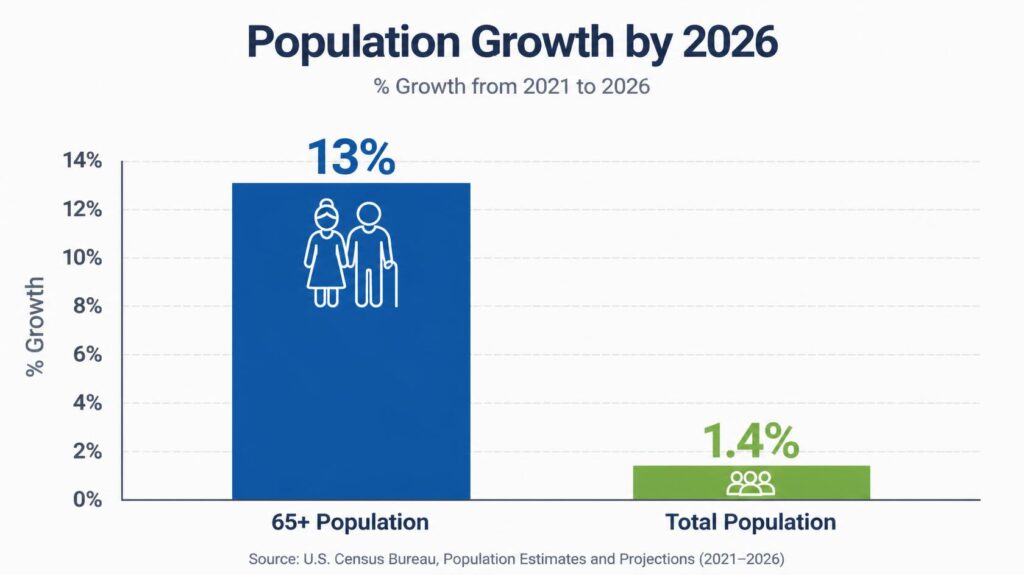
- Americans 65 and older grew by 13 percent
- Working-age adults grew by just 1.4 percent
- The number of children actually declined
This is the kind of timing Gross’s research treats as a green light—not a shift that might happen someday, but one that’s already measurable and picking up speed year over year.
It’s also why the demand behind services like move management, home safety modifications, mobile notary work for homebound seniors, and estate or downsizing help isn’t speculative. The customer base for all of it grows every year, faster than the population that would traditionally provide unpaid family help to absorb it.
Checking the Other Four Factors, Honestly
Timing being favorable doesn’t mean everything else takes care of itself. Here’s how the senior-care space holds up against the rest of Gross’s framework.
Idea and differentiation. The generic version of “senior care business” is crowded — home care agencies and general caregiving services are well-established. But the narrower angles this shift creates are far less saturated: move coordination for downsizing, notary services for people who can’t travel, safety modifications, estate liquidation for a parent’s home. Each solves a specific logistical problem rather than competing in the broad caregiving market.
Team. This is one of the more forgiving categories for a solo operator. None of these businesses require a clinical license or a large staff to start. They require organizational skill, patience, and the ability to build trust with an adult child making decisions on behalf of an aging parent. That’s learnable, not credentialed.
Business model. Most of these ideas have a straightforward, provable revenue path from day one — a flat fee, an hourly rate, or a commission — rather than a model that depends on scale or ad revenue to eventually work.
Funding. This is arguably the strongest fit of all. Every business in this cluster can be started with minimal upfront capital — no inventory, no lease, no equipment financing. Gross’s own research found funding to be the least important of the five factors, which lines up with how low the barrier to entry is here.
Real Businesses Already Built on This Timing
This isn’t theoretical. It’s the same demographic argument behind every business idea already covered here in detail:
- How to Start a Senior Move Management Business
- How to Start a Mobile Notary Business for Homebound Seniors
- How to Start an Estate Sale Business Helping Families Downsize a Parent’s Home
- How to Start a Senior Home Safety Business
- Elderly Parents Fall Prevention Checklist
Each one solves a different piece of the same underlying shift — adult children increasingly managing logistics for aging parents who are living longer and, in growing numbers, living alone.
The Honest Caveat
Good timing explains why a category of business is worth considering. It doesn’t excuse skipping the rest of the work.
The businesses in this cluster that succeed will still be the ones that pick one specific, narrow angle instead of trying to serve “seniors” broadly. They’ll build real referral relationships with the professionals — elder law attorneys, real estate agents, and senior living communities — who are already trusted by this exact customer base.
Timing is the tailwind. It’s not a substitute for execution.
FAQ
Is senior care oversaturated as a business category? The broad category — general home care and caregiving agencies — is well-established and competitive. The narrower, logistics-focused niches this demographic shift creates (move coordination, downsizing, mobile notary work, and safety modifications) are considerably less crowded because they solve a specific problem rather than competing as general caregiving.
Do I need a license or certification to start one of these businesses? It depends on the specific business. Estate sales, move management, and home safety consulting generally don’t require a special license, though business registration and insurance are standard. Notary work requires a state notary commission. Always check your state’s specific requirements before starting.
How long will this demographic shift continue to create demand? The gap between the older and younger population has been narrowing every year — from about 20 million in 2020 to just under 12 million by 2024 — and current census projections have older adults overtaking children within the next decade. This isn’t a short-term spike; it’s a multi-decade trend.
Keep Reading
For the broader patterns behind why some low-budget business ideas succeed while others don’t, see The Startup Strategies That Build Successful Businesses