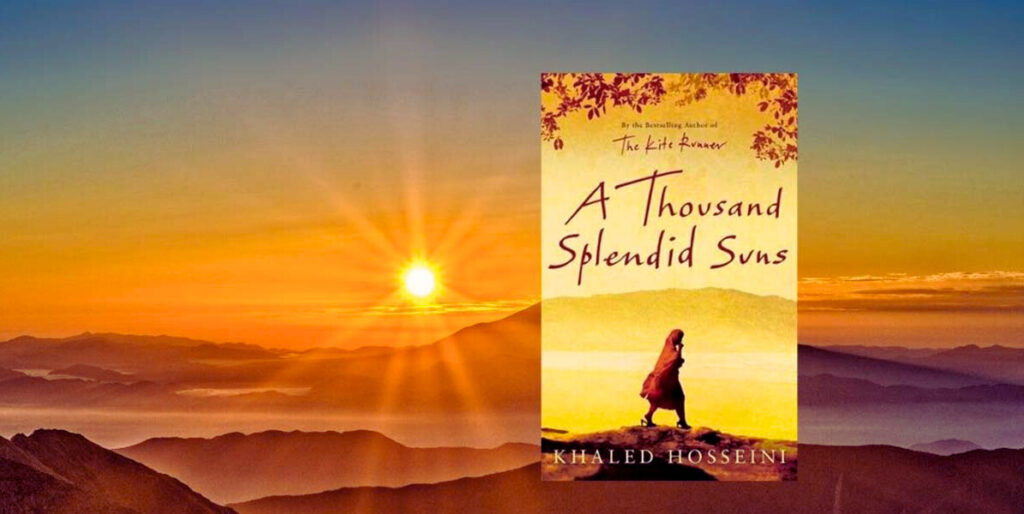
Unbroken Women Beneath A Thousand Splendid Suns
Khaled Hosseini’s wildly popular novel about a woman’s sacrifice is eye-opening and inspiring.
By Sarah, published on Saturday, January 17, 2026
A Thousand Splendid Suns leaves you hollow, but it also leaves you aware—aware of pain, of love, and of the devastating cost of silence.
“It is a story carved from grief, where love blooms only to be buried, where hope flickers just long enough to hurt, and where surviving of women means carrying the ghosts of everything that was never allowed to live.”
A Thousand Splendid Suns is a novel that does not merely tell a story—it bears witness. It opens its arms slowly, almost gently, and then closes them around your throat. By the time the final page is reached, the reader is left bruised, grieving, and changed. Khaled Hosseini crafts a narrative so intimate and merciless that it feels less like fiction and more like the collective memory of suffering passed down through generations of Afghan women whose voices were never allowed to rise above whispers.
A Thousand Splendid Suns is not a novel you read—it is a novel you survive. It drains you slowly, deliberately, until grief feels heavy in your hands. Every chapter tightens around the heart, every sentence presses on old wounds you didn’t know you carried. Khaled Hosseini writes with a kind of devastating restraint, never begging for tears, never forcing emotion—yet somehow leaving the reader utterly undone. This is a story about women who are taught from birth that their pain is ordinary, that their silence is virtue, and that love, if it comes at all, will come wrapped in sacrifice.
Mariam’s (woman) story begins with abandonment, and abandonment never truly leaves her. She is born already apologizing for her existence. Labeled a harami, she grows up believing that her life is a mistake that must be quietly endured. Nana’s bitter warnings—“Like a compass needle that points north, a man’s accusing finger always finds a woman”—are not cruel exaggerations; they are prophecies. Mariam waits her whole childhood for a single act of recognition from Jalil, and when it never comes, the moment shatters something permanently inside her.
When Nana dies, Mariam (woman) does not just lose her mother—she loses the last person who claimed her. From that moment on, the world teaches her the same lesson again and again: you are replaceable, you are undeserving, you are alone.
Rasheed, Mariam’s husband, is not immediately monstrous, which makes his transformation even more horrifying. His disappointment at Mariam’s miscarriages curdles into resentment, then violence. The abuse is not cinematic; it is mundane, repetitive, and exhausting.
Hosseini forces the reader to endure it the way Mariam does—without escape, without justice. Each slap, each insult, each act of control erases another piece of her until she is convinced that suffering is simply what she was made for. And yet, within her brokenness, Mariam holds an astonishing capacity for love, even when she believes she does not deserve it. Her marriage to Rasheed is where the novel becomes almost unbearable.
Hosseini does not sensationalize abuse; he normalizes it, which is far more horrifying. Rasheed’s love is conditional, his patience thin, and his violence methodical. The miscarriages strip Mariam not only of children but also of her last protection. Each loss is another nail sealing her fate. The scene where Rasheed forces her to chew pebbles—humiliating, degrading, animalistic—is not just physical cruelty; it is symbolic. Mariam is reduced to something less than human, and the most heartbreaking part is how easily the world allows it.
Another woman, Laila, enters the story like a breath of air, but even her life is shaped by loss. Raised by educated parents who believe fiercely in her future, Laila grows up with hope—something Mariam never had the luxury to possess. Laila (woman) is everything Mariam (woman) was never allowed to be. She has parents who believe in her mind, her future, and her right to dream. And Hosseini destroys that future in a single explosion.
The death of Laila’s parents is written with chilling suddenness, as if to remind the reader how quickly life can be erased. One moment, she is a daughter; the next, she is rubble. Orphaned, wounded, and pregnant, Laila is forced into marriage not out of desire, but desperation. Her wedding to Rasheed feels like a funeral—of youth, of choice, of freedom. That hope is annihilated by war. The bombing that kills her parents is one of the most devastating moments in the novel, not just for its violence, but for its suddenness. One moment, Laila (woman) has a home, a family, and a past; the next, she has nothing. Injured, orphaned, and pregnant, she is forced into the same prison as Mariam: marriage to Rasheed.
What follows is one of the most powerful portrayals of female solidarity in modern literature. Mariam and Laila begin as rivals, pitted against each other by Rasheed’s cruelty and patriarchal control. Their initial hostility is painful to read because it mirrors how oppression turns victims against one another. What makes the novel devastating rather than merely tragic is the relationship between Mariam and Laila. At first, they are strangers bound by resentment and fear. Rasheed pits them against each other, and for a while, it works. But suffering has a way of forging intimacy.
Slowly, almost imperceptibly, love grows between them. Not the romantic kind, but something deeper and rarer—a love born of shared bruises, shared hunger, and shared terror. When Mariam begins to see Laila not as a rival but as a daughter, and Laila begins to see Mariam as a mother, the novel reaches its emotional core. Their bond becomes the only tenderness in a world that offers none. Slowly, tentatively, they reach for each other. In stolen glances, shared chores, and whispered conversations, a bond forms—one that becomes the emotional core of the novel. They are not just co-wives; they become mother and daughter, sisters, and lifelines. In a world that has stripped them of agency, their love becomes an act of quiet rebellion.
The novel is relentless in its depiction of suffering, particularly under Taliban rule. Women are erased from public life, reduced to shadows behind burqas, and beaten for the smallest infractions. Hosseini does not allow the reader to look away. Laila’s failed attempt to escape with Mariam is especially crushing. The brief flicker of hope—of freedom—is extinguished brutally, followed by one of the most harrowing scenes of punishment in the book. Rasheed’s violence reaches a terrifying peak, and the home becomes a battleground where survival is no longer guaranteed.
And then comes the moment that breaks the soul of the novel.
When Rasheed tries to kill Laila, Mariam’s choice is impulsive. There is no grand speech, no hesitation—only clarity. For the first time in her life, Mariam chooses herself by choosing someone else. Her act of violence is an act of love. In that moment, she transforms from the unwanted child into a woman of consequence. Later, as she awaits her execution, Mariam reflects that “she was leaving the world as a woman who had loved and been loved back.” That single realization—so small, so late—hurts more than any beating in the book. It is devastating to know that a lifetime of suffering is redeemed by only one brief season of love.
Mariam’s death is quiet. There are no witnesses, no justice, and no legacy carved in stone. She dies the way she lived—unseen by the world. And yet, she is the most unforgettable presence in the novel. Her sacrifice echoes through Laila’s future, through every moment of survival, and through every small act of rebuilding. Mariam (woman) becomes proof that even the most erased lives matter deeply.
By the end of A Thousand Splendid Suns, the reader is left hollowed out. The title feels almost cruel in its beauty. Where are the splendid suns in a world so brutal? And then you realize—they are Mariam and Laila, and women like them.
Burning quietly, enduring endlessly, lighting the dark even as they are consumed by it.
This book is heartbreaking because it does not look away. It tells the truth slowly, painfully, and without mercy. It leaves you grieving not only for fictional characters but also for real lives mirrored in their suffering. A Thousand Splendid Suns does not offer comfort—it offers remembrance. And that, somehow, hurts even more.
Mariam’s final act is the most devastating and meaningful moment in the novel. For the first time in her life, she makes a choice—one that is entirely her own. In killing Rasheed to save Laila, Mariam transforms from a woman who believed she was nothing into someone who understands the depth of her worth.
Her decision to stay behind, to accept her execution so that Laila and the children can escape, is not framed as heroic in a traditional sense. It is quiet, resigned, and unbearably sad. Mariam dies believing that, for once, her life mattered—that she was loved, that she was useful, that she was enough. The reader is left shattered by the injustice of it all: that it took death for Mariam to find peace.
By the time Laila returns to Kabul years later, the city is scarred but still standing—much like the women who endured it. Mariam’s memory lingers in every act of kindness, every attempt to rebuild, and every moment of love that survives despite everything. The title, A Thousand Splendid Suns, comes to feel painfully ironic and deeply sincere all at once. The splendor is not in the world Hosseini depicts, but in the resilience of those who endure it.
This novel is heartbreaking because it is honest. It does not offer comfort, only truth. It asks the reader to sit with suffering, to mourn lives that were never allowed to flourish, and to recognize the quiet strength that exists even in the most broken places. A Thousand Splendid Suns leaves you hollow, but it also leaves you aware—aware of pain, of love, and of the devastating cost of silence.