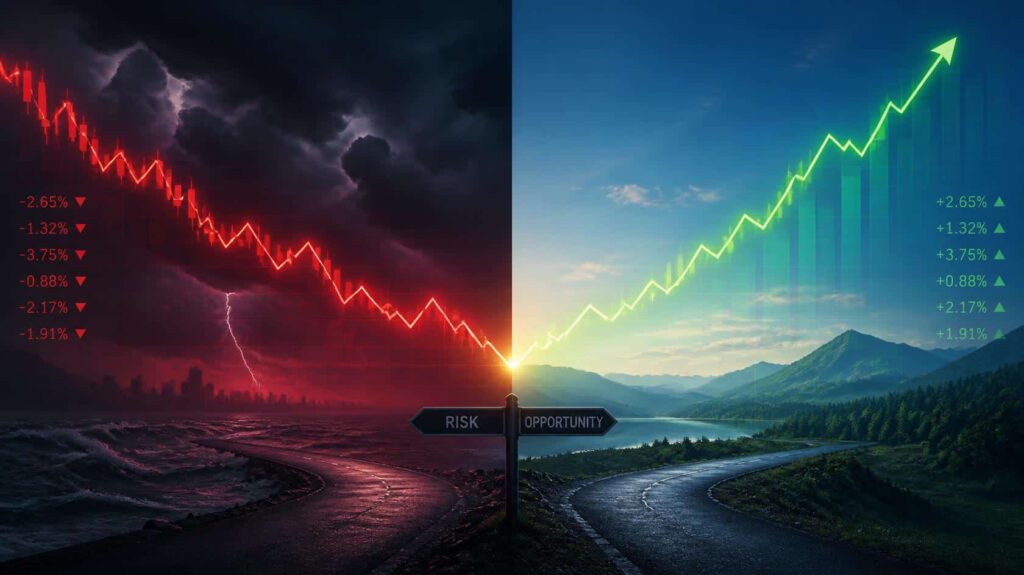
Is it safe to invest right now?
Short answer: There’s no guarantee at any point in time.
The specific fear driving this question right now is a genuine disagreement between credible experts, not a settled fact. Some well-known investors are warning of a 2026 crash. Other respected economists say the market is in normal, healthy shape.
That uncertainty is exactly why panic-selling, or refusing to invest at all, tends to hurt beginners more than the crash itself would.
Below, we’ll walk through exactly what each side is saying, why even expert crash predictions have a surprisingly weak track record, and what that means for what you should actually do with your money.
Stock Market Crash 2026: Why Experts Like Michael Burry Are Sounding the Alarm
Two well-known investors, Michael Burry and Peter Schiff, have both been warning publicly that a crash could hit in 2026. Here’s what they’re basing that on.
Michael Burry is the investor who became famous for correctly predicting the 2008 housing market crash. In 2026, he has been warning that today’s stock market reminds him of the final months before the dot-com crash of 1999-2000, when internet company stocks were wildly overpriced and then collapsed.
To explain why, Burry points to something called the Shiller CAPE ratio. This is a way of measuring whether stocks are expensive or cheap, based on company earnings over the past ten years, adjusted for inflation. Historically, this number has averaged in the high teens. In mid-2026, it climbed above 40, a level it only reached once before, right at the peak of the dot-com bubble. Burry isn’t only talking about this either; he has actually placed bearish bets against semiconductor stocks, meaning he stands to make money if those stocks fall in value.
Peter Schiff, another well-known market skeptic who has long favored gold as an investment, has made a similar warning. He has called the U.S. stock market a “ticking time bomb,” pointing to high stock prices, a weakening U.S. dollar, and bonds that he considers unattractive right now. His advice to investors is to move money out of U.S. stocks and into gold, other commodities, and international markets instead.
It’s worth knowing that both Burry and Schiff have made dramatic warnings like this before in past years that did not turn into the crash they predicted, at least not on the timeline they expected. That doesn’t mean they’re wrong this time, but it’s useful context before deciding how much weight to give their warnings.
Want to see if your favorite stock is currently trading at a discount or premium? Try our free Stock Intrinsic Value Calculator powered by Benjamin Graham’s valuation formula.
Is the Stock Market Overvalued? Why Some Economists Say No
That’s the case for worry. But Burry and Schiff don’t speak for the whole field, and not every respected voice in finance shares their concern.
Jeremy Siegel, a professor emeritus of finance at the University of Pennsylvania’s Wharton School, has taken a much calmer view throughout 2026.
Just a few days ago, in a talk addressing exactly the kind of fears people have right now, Siegel explained that the stock market is currently trading at about 20 times company earnings. He said this is close to the reasonable long-term average he has used in his own research for decades, not an extreme or bubble-like level. In his view, the current high stock prices are being supported by real economic growth and by genuine productivity gains from artificial intelligence, which he compares to the boost the economy got from the early internet. Siegel is not predicting huge stock market gains either; he expects fairly modest growth, somewhere in the high single digits to low double digits, which would be a normal year, not a crash and not a boom.
What Does Warren Buffett Say About a 2026 Crash?
Warren Buffett takes a third position that doesn’t fit neatly into either camp. Buffett has said repeatedly that trying to predict short-term stock market movements is essentially impossible, even for the most experienced investors, and has compared relying on such predictions to poison. His long-standing philosophy is to be cautious when other investors are feeling greedy and to invest more when other investors are feeling fearful. What’s notable right now is that his own company, Berkshire Hathaway, has been a net seller of stock for three consecutive years, which suggests that even Buffett hasn’t found many stocks he considers reasonably priced lately. He hasn’t called for a crash, but his actions suggest a degree of caution that sits somewhere between Siegel’s calm and Burry and Schiff’s alarm.
A recent investor sentiment survey adds some useful context here too. According to a late August 2026 poll from the American Association of Individual Investors, close to 45% of investors expected stock prices to fall over the following six months, while only about a third expected the market to keep climbing.
In other words, the disagreement between these experts is mirrored in how everyday investors feel about the market right now; there’s no clear consensus in either direction.
Stock Market Crash Predictions: Why They’re Rarely Accurate
So you have two sides, both led by credentialed people, reaching opposite conclusions from the same market. Before deciding who to believe, it helps to know something both sides have in common: predicting exactly when a crash will happen is extremely difficult, even for experienced, knowledgeable people.
Robert Kiyosaki, the author of the popular book Rich Dad Poor Dad, has publicly predicted major stock market crashes multiple times since the early 2000s, including in 2011, 2016, and 2022. In each case, the crash he predicted either did not happen at all, or the market recovered and grew strongly within about a year afterward.
This isn’t really about Kiyosaki being unreliable; specifically, it’s a pattern that shows up again and again with market forecasters in general. Even respected tools like the Shiller CAPE ratio mentioned earlier, or the “yield curve inversion” (a signal based on bond interest rates that has preceded past recessions), don’t have a strong track record of correctly predicting exactly when a downturn will start.
Research on these indicators has found that the time between a warning signal and an actual downturn can range anywhere from a few months to more than two years. That’s much too long a window to be useful for making a quick decision about whether to invest today or wait.
One investing podcast recently looked back at seventeen years of predictions from a well-known market forecaster and found something similar: even though that person had a couple of dramatically correct calls, their overall track record over the full period was mixed. Being right once in a memorable way is not the same thing as being reliably right most of the time.
Should You Invest Now or Wait for a Market Crash? What Beginners Should Do
Given all of that, real experts disagreeing and even the best forecasters having a mixed track record, what should you actually do with your own money? None of this means you should ignore risk completely. It means you shouldn’t make a big decision, like pulling all your money out of the stock market or refusing to start investing in the stock market at all, based only on one analyst’s prediction, no matter how experienced they are.
Here are a few practical things that actually help, based on what tends to work over the long run:
- Don’t rely on any single prediction, in either direction. Both the bears (Burry, Schiff) and the bulls (Siegel) have solid credentials, and they disagree. That disagreement itself tells you that nobody can predict this with certainty right now.
- Selling out of fear usually makes things worse, not better. If you sell your investments after prices drop because you’re scared, you only come out ahead if you also correctly guess when to buy back in, and that second part is exactly what even professional investors struggle with.
- Spreading your money across many companies protects you. Instead of investing in just one company or one industry, a broad index fund holds pieces of hundreds of different companies. This means if one part of the market has a problem, for example, if AI-related stocks turn out to be overvalued, it won’t wipe out your entire investment.
- Keep your emergency savings separate from your investments. Money you might need soon, like for rent or bills, should not be sitting in the stock market. A lot of the panic people feel during a downturn comes from having money invested that they actually needed to be safe and accessible.
- Investing a fixed amount regularly takes the guesswork out of it. If you invest the same amount every month, no matter what the market is doing that day, you end up buying some months when prices are high and some months when they’re low. Over time, this evens out, and you never have to correctly guess the “best” moment to invest.
If you haven’t started investing yet and want the basics first, how much money you actually need, how to pick a brokerage, and why index funds are usually the safer starting point, our beginner’s guide to investing in the stock market covers all of that from scratch.
Stock Market Crash FAQ: Your Top Questions Answered
Is it safe to invest in the stock market right now?
Safety isn’t really about the calendar date; it’s about whether you’re investing money you won’t need soon and whether your portfolio is spread across enough companies to absorb a downturn. If both of those are true, the current disagreement among analysts matters less than it might seem.
Should I wait for a crash before I start investing?
Trying to wait for the “perfect” low price usually just means guessing, and even professional analysts with decades of experience get that guess wrong often. Historically, people who kept investing steadily and consistently have ended up better off than people who tried to time their entry perfectly.
Is Michael Burry’s crash warning something I should trust?
Burry has a genuinely strong track record, including famously predicting the 2008 financial crisis correctly. At the same time, he has also made bearish predictions in more recent years that didn’t turn out to be accurate. His concerns are worth understanding and taking seriously, but not worth following blindly.
What should I do if the market crashes after I’ve already invested?
Historically, what determines whether someone ends up okay after a crash isn’t really whether the crash happened; it’s whether they panicked and sold during it. Investors who stayed invested and diversified through past downturns have generally recovered and grown their money well beyond where it was before the crash, given enough time.
Are stock prices really as high as they were during the dot-com bubble?
By one measurement, the Shiller CAPE ratio, yes, it has reached a level last seen in the year 2000. By another measurement, the one Jeremy Siegel uses, current prices look closer to a normal, reasonable level. Two credible experts are looking at the same market and reaching different conclusions, which is itself a useful thing to know: right now, nobody actually has certainty about this.
What does Warren Buffett say about a potential 2026 crash?
Buffett has long argued that predicting short-term stock market movements is essentially impossible, even for expert investors. His approach is to be cautious when others are greedy and to invest when others are fearful. Notably, his company, Berkshire Hathaway, has been a net seller of stock for three straight years, which suggests he’s currently finding few bargains, even though he hasn’t predicted a crash outright.