
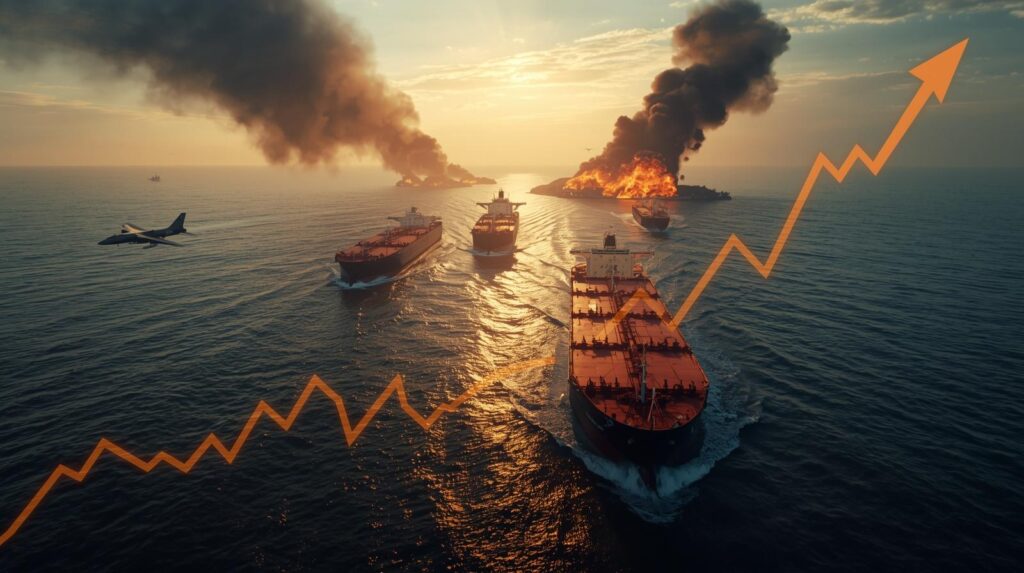
In today’s world, energy prices aren’t just an economic factor—they’re the heartbeat of global markets. Energy greases the wheels of the economy, and it’s felt in just about everything that we produce or consume. Oil is an input cost for nearly every company that makes anything because energy costs are derived primarily from the price of oil.
History has shown that the effects of war rarely remain confined to the battlefield. They show up in everyday life.
The most direct consequence of rising oil prices is higher gas prices. The connection is simple: higher oil prices increase costs across industries, squeeze corporate profits, and raise inflation risks. Gas prices at the pump in the U.S. have jumped by the most since 2022. And when the price of gas goes up, the price of everything goes up. The cost of driving, sure, but also the cost of flying, the cost to make all kinds of things, the cost to deliver absolutely anything.
Energy prices are higher, both oil and natural gas prices, which is a problem for parts of the world that rely on fossil fuels for their economy. The consequences will be a hit to activity and higher inflation. The impact is still uncertain. A lot depends on how long this conflict lasts.
Now, the situation is intensifying:
- Shipping companies are pausing operations
- Tankers are being rerouted away from risk zones
- Insurance and security costs are rising
As a result, analysts are warning that oil prices could surge toward $100 per barrel if disruptions continue.
The Impact of Conflict on Oil Prices
Even before recent military strikes, oil markets were already reacting to uncertainty. Brent crude oil had climbed to a seven-month high, trading above $70 per barrel due to fears of escalating conflict.
Due to ongoing tensions in the Middle East, traffic through the Strait of Hormuz has nearly ground to a halt. Rising friction between the United States and Iran has made one of the world’s most vital shipping lanes increasingly uncertain—and, for many operators, too risky.
The US-Iran war is inflationary. It raises the price of oil. Oil prices have been on a roller coaster ride since the U.S. and Israel launched their war against Iran. Oil futures are spiking again to more than $100 a barrel.
So, to get this straight,
The U.S. and Israel bomb Iran. Iran threatens to attack oil tankers in the Strait of Hormuz.
Every day, massive tankers crisscross the oceans, carrying the lifeblood of the global economy—oil and gas. For decades, these shipments followed predictable paths, with key chokepoints like the Strait of Hormuz serving as critical arteries. But today, those long-established routes are undergoing a dramatic transformation.
Iran remains one of OPEC’s key producers, pumping just over 3 million barrels of crude oil per day. While that number is significant on its own, the real concern is that Iran borders the Strait of Hormuz, one of the most critical oil choke points in the world. Roughly 20% of the global oil supply passes through this narrow route. Any disruption here doesn’t just affect regional exports—it threatens global energy
The disruption to traffic through the Strait of Hormuz is causing nerves in the oil markets, and attacks by Iran on energy infrastructure in Saudi Arabia are again causing fears that the supply of oil might be curtailed
The United States is also the single largest oil consumer in the world, about 20% of the entire planet’s oil consumption. It imports millions of barrels of oil a day, which, again, it now has to pay a higher price for
Oil prices and the stock market
Markets don’t wait for shortages—they react to fear and risk.
Energy uncertainty is now shaping investor behavior. That combination makes investors cautious, leading to volatility in stock markets. Rather than moving on traditional economic indicators, the index is now fluctuating with shifting expectations around the conflict
What we’re seeing now is a market driven less by fundamentals and more by uncertainty. Oil companies make a lot of money. They’re the ones profiting the most by pumping a commodity out of the ground that is suddenly more valuable. Oil-producing states make money. But consumers, anybody in the broader economy, pay more. They feel inflation. And so it’s obviously going to impact everything.
And until there’s clarity on both oil supply and the duration of the conflict, that instability is likely to continue.
The market seems to be moving on headlines—on how long the conflict might last or whether there’s any chance of it easing. One moment, there’s optimism and buying. Next, uncertainty creeps back in, and stocks pull lower.
At the core, it’s pretty straightforward. When oil prices rise, everything gets more expensive—transport, production, operations. That eats into company profits and raises concerns about inflation. And when investors start worrying about those things at the same time, caution takes over.
That’s really what we’re seeing: not panic, but hesitation.
Markets right now aren’t being driven purely by fundamentals. They’re being shaped by uncertainty—about supply, about geopolitics, about what comes next. And until there’s some clarity on those fronts, this back-and-forth in the markets is likely to stick around
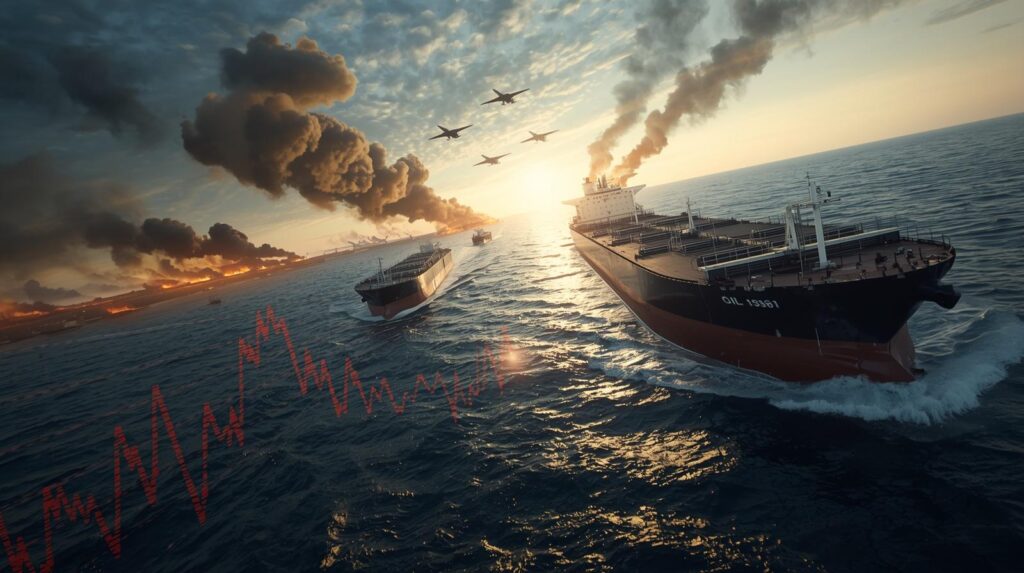
How a Single Strait Is Transforming Global Energy
The US-Iran war has sent energy prices higher. So far, the price of oil has hovered around $100 a barrel. How high could it go if the conflict drags on and the Strait of Hormuz remains disruptive?
Iran’s position near the Strait of Hormuz makes it one of the most important players in global energy. With nearly 20% of the world’s oil passing through this narrow route, even the risk of disruption is enough to shake markets and push prices higher.
But the impact doesn’t stop at rising oil prices. It is now triggering a much bigger shift in how energy moves around the world.
And in today’s interconnected world, that means one thing
When energy routes change, the entire global economy changes with them
A Rapid Shift Toward the United States
In response to rising risks in the Middle East, global energy flows are changing fast.
A growing number of oil tankers are now heading toward the United States, reinforcing its role as one of the world’s leading oil and gas producers.
This is not just a short-term reaction.
It signals a deeper transformation in the global energy system, where countries are actively reducing reliance on high-risk regions and looking for more stable supply sources.
The key question now is
Is this just a temporary disruption caused by conflict or the beginning of a long-term shift in global energy power?
As tensions rise, companies and governments are rethinking energy logistics:
- Oil is being transported through longer, safer routes
- Shipping costs are increasing
- Geopolitical risk is now a major factor in decision-making
What used to be a stable and predictable network is becoming more flexible, complex, and uncertain.
These changes are not happening in isolation—they have direct economic consequences:
- Higher shipping costs → higher oil prices
- Higher oil prices → increased inflation
- Increased inflation → pressure on global economies
Because oil is traded globally, even small disruptions can create large ripple effects across markets.
The International Energy Agency says it is the largest energy crisis the world has ever experienced. But while no country will be spared, the burden, of course, will not be shared equally. The poorest will suffer the most
How Rising Oil Prices Are Shaping the Global Economy
The global energy system is under growing pressure as supply chains struggle to adjust. Tanker ships are being redirected from the U.S. to Asia, and rebalancing the global fleet could take up to 12 weeks. At the same time, many oil and gas fields in the Gulf have shut down, and restarting them won’t be quick—some may recover in weeks, while others could take months. According to the International Energy Agency, more than 80 energy facilities have been damaged, including Qatar’s Ras Laffan LNG hub, which has already lost around 17% of its capacity and may take years to fully repair.
As supply continues to tighten, oil prices are rising and starting to impact the broader economy. The International Energy Agency now expects oil demand to shrink by 80,000 barrels per day, a sign that economic activity is slowing down. Reflecting this, the International Monetary Fund has lowered its global growth forecast from 3.4% to 3.1% and increased its inflation outlook to 4.4%, showing that the effects of the crisis are spreading beyond energy markets.
The impact will be felt most strongly in developing countries that rely heavily on imported energy. Many regions, especially in Africa, are already facing fuel shortages, and weaker economies risk being pushed into deeper crisis. What started as a supply disruption is now turning into a wider economic challenge, affecting growth, inflation, and global stability.